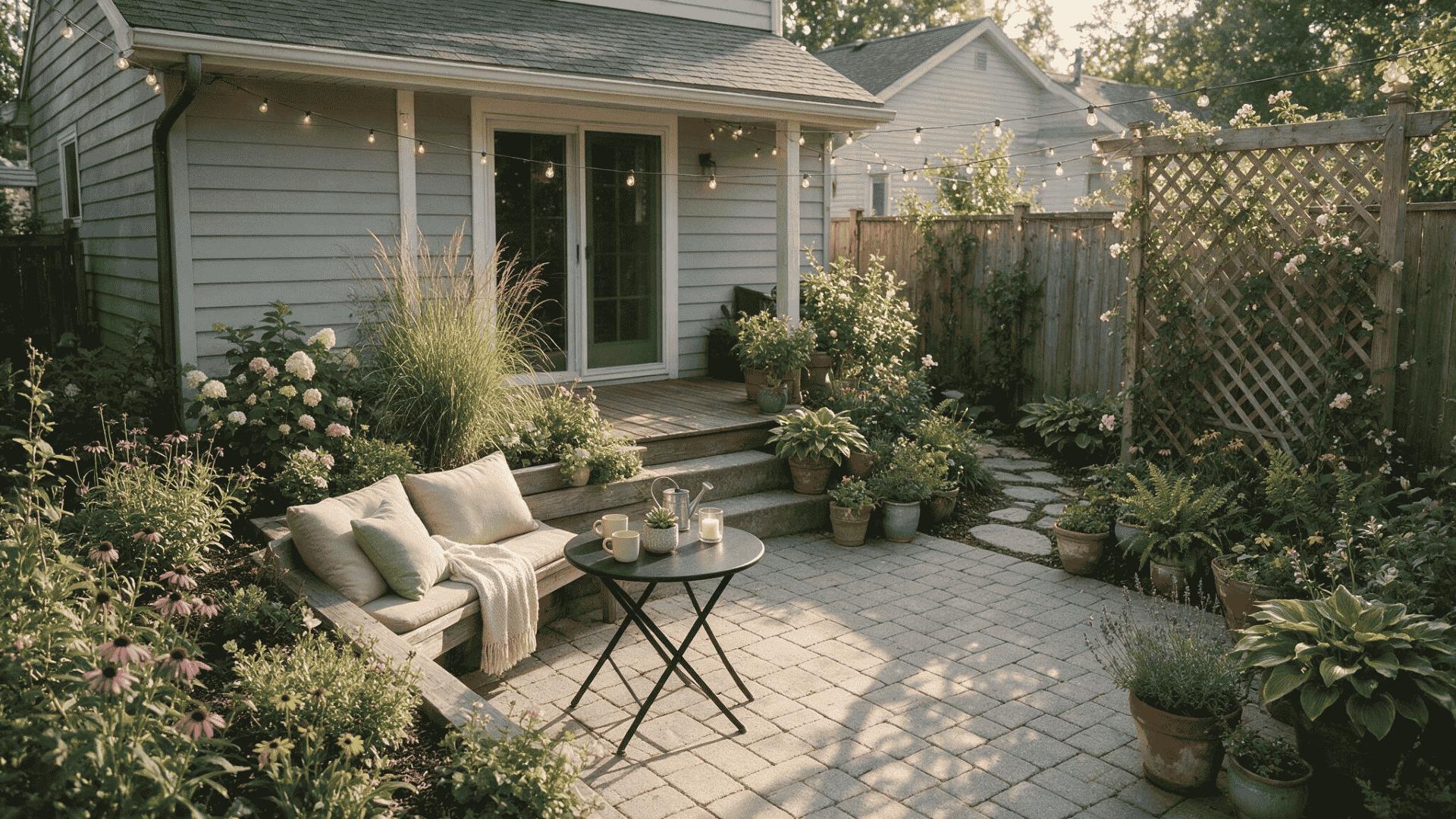
A small backyard can feel smaller than it is once furniture and plants start filling it. One extra chair or an oversized pot is often all it takes to block a path.
I’ve noticed the real issue is rarely the size of the yard itself. It usually comes down to choosing a few features with real intention instead of adding items at random.
You don’t need a larger yard to make it more comfortable. A clear plan, built around how you actually use the space, is what turns a handful ofsmall backyard ideas into a yard that works.
How to Plan a Small Backyard?
Start by measuring the yard and marking doors, gates, steps, faucets, drains, utility boxes, and existing trees. Track direct sunlight for one full day before deciding where seating or plants should go.
Choose one main purpose, such as dining, gardening, playing, or reading. Then mark possible features with stakes, string, or a garden hose and walk through the arrangement before buying or building anything.
Pay attention to the view from inside your home, too. A bench, compact tree, or planted border positioned across from a window can make the backyard feel connected to your living space.
Small Backyard Layout Ideas:
|
Layout choice |
Best use |
Practical tip |
|---|---|---|
|
Two or three zones |
Dining, planting, and relaxing |
Define areas with furniture or ground materials, not tall barriers. |
|
Curved or diagonal lines |
Narrow or rectangular yards |
Use one broad curve instead of several tight bends. |
|
Open center |
Children, pets, or gatherings |
Place beds and fixed seating around the edges. |
|
Clear destination |
Long, narrow yards |
End the path at one focal point, like a large planter or a gate. |
The Best Small Backyard Ideas
The best small backyard ideas solve a real need while leaving enough room to move. Select options that suit your available space, local climate, maintenance time, and the activities you enjoy outdoors.
1. Add a Built-In Bench

If loose chairs keep interrupting your walkway, a built-in bench can give you that floor space back. Run it along a fence, retaining wall, or patio edge that already forms a natural boundary.
A seat approximately 17 to 19 inches high and 18 inches deep should feel comfortable for most adults. I would add a gently angled backrest if you plan to sit there for more than a quick coffee.
- Best for: Creating permanent seating along an unused boundary
- What to choose: Cedar for natural warmth or capped composite for easier upkeep
- Check first: Leave access to fence panels, drains, outlets, and utility boxes
- Color pairing: Try warm cedar with sage cushions or charcoal composite with cream fabric
2. Choose Furniture With More Than One Use

In a small yard, furniture should do more than sit still. A storage bench can hide cushions, an outdoor ottoman can become another seat, and nesting tables can separate when friends visit.
Measure each item when its lid, leaves, or folding parts are fully open. A compact piece isn’t helpful if it blocks the kitchen door when you use it.
- Best for: Yards that need to switch between relaxing, dining, and entertaining
- What to choose: Storage benches, nesting tables, lidded ottomans, or folding consoles
- Check first: Confirm open dimensions, storage ventilation, and furniture weight
- Product recommendation: The Keter Signature 60-Gallon Outdoor Storage Bench combines seating with enclosed storage
3. Create a Compact Dining Corner

Keep your dining corner close enough to the kitchen that carrying plates outside does not feel like a chore.
A round table around 30 to 36 inches wide generally works for two people without introducing corners that catch bags or hips.
A pedestal base also gives your legs more room beneath the table. If meals happen mainly on weekends, a fold-down design may be more useful than a permanent setup.
- Best for: Morning coffee, casual meals, and drinks for two
- What to choose: A round pedestal table or wall-mounted drop-leaf table
- Check first: Leave around 30 inches behind occupied chairs when space allows
- Product recommendation: The IKEA SUNDSÖ table and folding chairs suit a narrow patio and can fold away
4. Use Folding or Stackable Chairs

Extra chairs are useful when guests arrive, but they should not occupy your patio for the rest of the month. Look for chairs that fold flat or stack into a tidy group.
If you can, lift one before buying. Heavy steel can become annoying when you regularly carry four chairs to a shed. Powder-coated aluminum is lighter, while breathable mesh seats dry faster than thick cushions.
- Best for: Occasional gatherings and yards with changing furniture layouts
- What to choose: Lightweight frames, locking hinges, and replaceable furniture feet
- Check first: Compare chair weight, folded depth, load rating, and maximum stack height
- Color pairing: Black frames with terracotta pots create a warm, grounded combination
5. Build a Corner Patio

That empty corner may look like an obvious spot for a patio, but observe it before laying a single paver. Visit it in the morning and afternoon, then check it after rain.
A west-facing fence can make the space uncomfortably hot, while a low corner may collect water. Mark out a 6-by-6-foot area and arrange temporary chairs inside it to test the scale.
- Best for: Turning an overlooked corner into a separate sitting or grilling area
- What to choose: Firm pavers for dining furniture or gravel for a flexible setup
- Check first: Review sunlight, drainage, property boundaries, and permit requirements
- Color pairing: Blend warm gray pavers with tan furniture and deep green planting
6. Make a Gravel Sitting Area

A gravel sitting area can feel relaxed and settled, but only if you prepare the base correctly. Loose stones spread quickly if you pour them directly onto soil without compaction or edging.
Choose angular crushed gravel, which fits together more firmly than rounded pea gravel. Chairs with broad feet or runner-style bases will also remain steadier.
- Best for: Adding an informal seating area without pouring concrete
- What to choose: Angular crushed gravel with rigid metal, stone, or plastic edging
- Check first: Confirm the ground drains properly and can support a compacted base
- Color pairing: Use buff gravel with natural wood or blue-gray stone with black furniture
7. Add a Narrow Garden Path

A path should take you somewhere useful, such as a gate, bench, shed, or planting bed. Lay down a garden hose first and walk along both sides of it while carrying a watering can.
This quick test reveals awkward turns before you commit to digging. Closely spaced pavers work better than widely separated stones if children, older adults, or garden carts use the route regularly.
- Best for: Protecting plants and guiding movement through a narrow yard
- What to choose: Textured pavers, compacted fine gravel, or closely spaced stepping stones
- Check first: Test the width, drainage, stride length, and access for wheeled equipment
- Color pairing: Repeat a material already used on the house or patio for continuity
8. Grow Plants Vertically

Vertical planting gives vines somewhere useful to go instead of letting them spread across valuable ground. Match the support to the mature plant, not the small seedling you bring home.
Netting can support peas, but cucumbers, climbing roses, and woody vines need something stronger. Leave several inches between a trellis and the wall so you can prune behind it.
- Best for: Growing herbs, vegetables, or flowers without widening your beds
- What to choose: Netting for light crops or anchored metal supports for heavier vines
- Check first: Consider mature plant weight, wall access, sunlight, and watering reach
- Color pairing: A matte-black grid trellis stands out cleanly against warm wood fencing
9. Install a Slim Raised Bed

A narrow raised bed can give vegetables and herbs a proper home without taking over the yard. If you can access it from only one side, keep it about 18 to 24 inches wide so you can reach the back without stepping on the soil.
Taller beds are easier on your back, but they also require considerably more soil, so calculate the volume before ordering.
- Best for: Herbs, lettuce, radishes, strawberries, and compact peppers
- What to choose: Cedar for warmth or galvanized steel for thinner, longer-lasting sides
- Check first: Calculate soil volume and confirm the ground beneath it drains well
- Product recommendation: The Vego Garden 6-in-1 Modular Raised Bed offers several layouts for fitting awkward spaces
10. Group a Container Garden

A row of unrelated pots can make a compact patio feel busier than it is. Instead, group three or five containers that share a color, shape, or material.
Place the tallest plant toward the back, add a fuller plant in the middle, and let one variety trail near the front. You will also find watering easier when the pots sit together.
- Best for: Bringing plants onto patios, decks, and paved courtyards
- What to choose: Three container sizes in terracotta, warm white, or muted green
- Check first: Confirm drainage holes and use pot feet on wood decking
- Color pairing: Mix terracotta with warm white, then repeat green through the plants
11. Plant Herbs Near the Kitchen

Grow the herbs you actually use rather than filling a planter with varieties that look good at the nursery. Rosemary, thyme, and oregano prefer sunnier, drier conditions.
Basil and parsley appreciate more regular moisture, so they may be easier to manage in a separate container. Keep mint on its own unless you want its spreading roots to dominate the bed.
- Best for: Keeping frequently used cooking herbs within easy reach
- What to choose: A narrow trough for compatible herbs and separate pots for mint
- Check first: Group plants by sunlight and watering needs, not appearance alone
- Color pairing: Galvanized planters look softer beside terracotta pots and green herbs
12. Create Partial Privacy

You may not need a tall fence around the entire yard. Sit in your usual chair and find the exact sightline that makes the space feel exposed.
One screen or tall planter at seated eye level can provide enough coverage while letting light and air move through the yard.
- Best for: Blocking a neighboring window, gate, or direct view into the seating area
- What to choose: A slatted panel, narrow evergreen, or trellis with a suitable vine
- Check first: Confirm property lines, height restrictions, wind exposure, and mature growth
- Color pairing: Cedar slats with a black frame work well beside green planting
13. Hang Outdoor String Lights

String lights feel more intentional when they define one activity area instead of wandering across the whole yard.
Run them above the dining table, around a pergola, or along the edge of a seating zone. Warm-white bulbs around 2200K to 2700K provide a softer glow than cooler blue-white light.
- Best for: Making dining and conversation areas more usable after sunset
- What to choose: Outdoor-rated LED bulbs with weather-resistant sockets
- Check first: Confirm strand length, bulb spacing, outlet location, and GFCI protection
- Product recommendation: Brightech outdoor string lights include plug-in and solar choices for different yard layouts
14. Include a Small Water Feature

Choose a fountain for its sound as carefully as its shape. A bubbling basin creates a soft murmur, while water falling between several levels sounds stronger and may splash beyond the base.
I recommend listening to a working display before buying because photographs cannot tell you how loud the pump or falling water will be.
- Best for: Softening nearby traffic noise beside a sitting area
- What to choose: A self-contained recirculating fountain with an accessible pump
- Check first: Review splash range, cord location, cleaning access, and winter care
- Color pairing: A dark stone-look basin disappears naturally among dense green plants
Small Yard Landscaping for Different Conditions
Good small yard landscaping responds to the site you already have. Check daily sunlight, soil drainage, slope, foot traffic, and regional weather before selecting plants or changing the ground surface.
|
Yard Type |
Main Challenge |
Best Approach |
Extra Tip |
|---|---|---|---|
|
Shady yards |
Limited direct sunlight |
Track sun hours and choose suitable shade plants |
Use pale flowers or light foliage for contrast |
|
Sunny yards |
Faster moisture loss |
Group plants with similar water needs |
Mulch bare soil to reduce evaporation |
|
Narrow yards |
Limited width |
Use upright plants, slim borders, and one clear path |
Add a bench or compact tree at the far end |
|
Sloped yards |
Water runoff and uneven ground |
Watch drainage before planting or terracing |
Get professional help for steep slopes or retaining walls |
Final Thoughts
Your backyard should reflect how you plan to use it, not follow a design that looks impressive but feels impractical.
This measured approach helps you control costs, avoid overcrowding, and understand which features genuinely support your household. Base decisions on accurate measurements, local conditions, and outdoor-rated materials.
Frequently Asked Questions
How much does it cost to update a small backyard?
Costs vary widely by project. Simple DIY updates like mulch, cushions, or paint often cost under $200. A new patio typically runs $2,000 to $6,000, and a fuller backyard refresh with landscaping and lighting can run $3,000 to $10,000 or more.
Do I need to hire a professional for a small backyard?
Simple updates like planting, container gardens, and lighting are usually fine to do yourself. For structural, drainage, or electrical work, consult a qualified professional and check local permit rules.
How long does a small backyard update usually take to complete?
A single feature, like new lighting or a seating area, can often be finished in a weekend. A full layout change with new beds, paving, or a patio usually takes several weeks.